
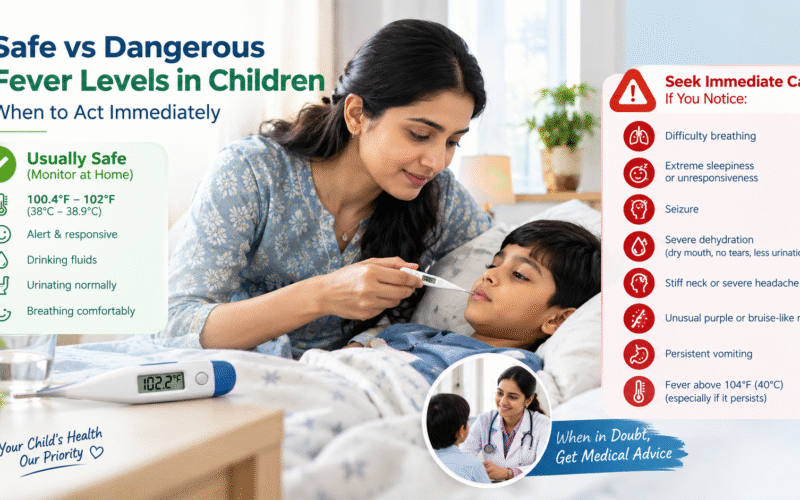
A fever in a child can be frightening for parents, especially when the thermometer shows a high number. But not every fever is dangerous. Fever is often the body’s natural response to an infection and can occur with common viral illnesses such as colds and flu.
What matters most is not just the temperature—it is also your child’s age, behavior, hydration, breathing, and other symptoms.
For parents, knowing the difference between a fever that can be monitored at home and one that requires urgent medical attention can help prevent unnecessary panic while ensuring timely treatment when it is needed.
What Temperature Is Considered a Fever in Children?
A temperature of 100.4°F (38°C) or higher is generally considered a fever in children. The exact reading can vary depending on the method used to measure temperature. A digital thermometer is recommended for accurate measurement.
The number on the thermometer is only one part of the picture. A child with a temperature of 102°F who is alert, drinking fluids and interacting normally may be less concerning than a child with a lower fever who is extremely sleepy or having difficulty breathing.
Understanding Fever Levels in Children
100.4°F–102°F (38°C–38.9°C): Usually Mild
This is a common fever range in children with infections.
If your child is:
- Drinking fluids
- Urinating normally
- Breathing comfortably
- Responsive and reasonably active
- Not showing serious symptoms
the fever can often be monitored at home while you observe the child closely.
The goal of fever care is generally to improve the child’s comfort rather than simply make the thermometer show a normal number.
102°F–104°F (38.9°C–40°C): Moderate to High Fever
A fever in this range does not automatically mean an emergency. Some children with viral infections can develop temperatures around this level.
However, parents should pay closer attention to the child’s overall condition.
Seek medical advice if the child:
- Is becoming increasingly weak or sleepy
- Is not drinking enough
- Has persistent vomiting or diarrhea
- Has difficulty breathing
- Develops a rash
- Has severe pain
- Continues to look or act unwell even after the fever comes down
A temperature above 104°F (40°C), particularly if it is repeated, warrants prompt medical evaluation.
Above 104°F (40°C): Seek Medical Advice Promptly
A temperature above 104°F is considered a high fever and should not simply be ignored.
Contact a pediatrician or seek urgent medical care, particularly if the fever is persistent or accompanied by concerning symptoms.
Remember: a high temperature alone does not determine how serious an illness is. The child’s behavior and other symptoms are equally important.
Fever in Babies Under 3 Months Needs Special Attention
One of the most important fever rules for parents is:
A baby younger than 3 months with a temperature of 100.4°F (38°C) or higher should receive prompt medical evaluation.
Young infants can become seriously ill quickly, and even a relatively low fever can be significant at this age.
Parents should not wait for the temperature to become very high before seeking medical advice.
When Is a Fever an Emergency?
Regardless of the exact temperature, seek immediate medical attention if your child has a fever along with any of these warning signs:
🚨 Difficulty Breathing
Fast or difficult breathing, struggling to breathe, or the chest pulling in with each breath can indicate a serious problem.
🚨 Extreme Sleepiness or Unresponsiveness
If your child is very difficult to wake, confused, unusually unresponsive or not behaving normally, seek emergency care.
🚨 Seizure
A seizure associated with fever requires medical evaluation, especially if it is the child’s first seizure.
🚨 Severe Dehydration
Watch for signs such as:
- Very dry mouth
- No tears while crying
- Significantly reduced urination
- Very dark urine
- Inability to keep fluids down
Dehydration can become serious in children.
🚨 Stiff Neck or Severe Headache
Fever accompanied by a stiff neck, severe headache or sensitivity to light can be a warning sign of a serious infection and requires urgent evaluation.
🚨 Unusual Purple or Bruise-Like Rash
A rapidly appearing purple, blood-colored or bruise-like rash with fever should be treated as an emergency.
🚨 Persistent Vomiting
If your child cannot keep fluids down because of repeated vomiting, medical attention may be necessary.
What Can Parents Do at Home?
If your child has a mild fever and otherwise seems well:
1. Encourage fluids
Offer water, breast milk, formula or other age-appropriate fluids to help prevent dehydration.
2. Keep clothing comfortable
Avoid excessive layers or heavy blankets. If your child is shivering, keep them comfortably warm without overheating.
3. Monitor behavior
Keep checking whether your child is alert, drinking, urinating and responding normally.
4. Use fever medicine only when appropriate
Medicines such as acetaminophen/paracetamol may be used for discomfort when appropriate for the child’s age and weight. Always use the correct dose recommended by your pediatrician or the medicine’s instructions.
5. Avoid unsafe fever remedies
Do not use ice baths or rubbing alcohol to try to reduce a child’s fever. These methods can be harmful.
How Long Can a Fever Last?
Many childhood infections cause fever for a few days. However, parents should contact a doctor if:
- The fever is getting worse rather than improving
- The child continues to look or act sick after the fever decreases
- Fever persists for more than 3 days in a child aged 2 years or older
- Fever persists longer than expected in a younger child
- The fever goes away and then returns
- New concerning symptoms appear
The American Academy of Pediatrics emphasizes that the child’s overall condition is an important factor when deciding how urgently medical care is needed.
The Bottom Line for Parents
A fever is not automatically dangerous just because the number is high.
Think beyond the thermometer. Ask yourself:
Is my child drinking?
Are they urinating normally?
Are they alert and responsive?
Are they breathing comfortably?
Are there any unusual rashes, seizures, severe pain or persistent vomiting?
If the answer to these questions is concerning—or if your child is very young—don’t wait for the fever to become higher.
When in Doubt, Get Medical Advice
At Noble Hospital, parents are encouraged to take changes in a child’s condition seriously. Early medical evaluation can help identify the cause of fever and determine whether your child needs simple supportive care or further treatment.
If your child’s fever is accompanied by breathing difficulty, unresponsiveness, seizure, severe dehydration, stiff neck, unusual rash or other emergency symptoms, seek immediate medical care.
Leave a Reply