
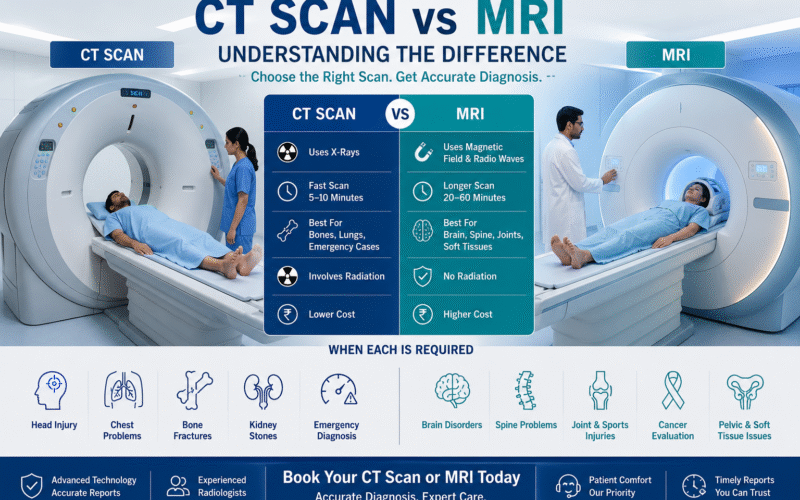
Understanding the Difference Between CT Scan and MRI: Which Scan Do You Need?
When your doctor recommends an imaging test, you may wonder whether you need a CT scan or an MRI. Both are advanced diagnostic imaging techniques that help doctors identify diseases, injuries, and abnormalities inside the body. However, they work differently and are used for different medical conditions.
Understanding the difference between CT scan and MRI, their advantages, limitations, and when each is recommended can help you make informed healthcare decisions. If you’re looking for accurate and timely diagnostic services, choosing a trusted diagnostic center ensures reliable results and expert guidance.
What is a CT Scan?
A Computed Tomography (CT) Scan uses multiple X-ray images combined with computer technology to produce detailed cross-sectional images of the body’s internal structures.
CT scans are extremely fast and are commonly used in emergency situations because they can quickly detect:
- Bone fractures
- Internal bleeding
- Stroke
- Lung diseases
- Kidney stones
- Chest injuries
- Tumors
Advantages of CT Scan
- Very fast (typically 5–10 minutes)
- Excellent for imaging bones and lungs
- Best choice during emergencies
- Widely available
- Lower cost compared to MRI
What is an MRI?
Magnetic Resonance Imaging (MRI) uses powerful magnets and radiofrequency waves instead of X-rays to create highly detailed images of soft tissues and organs.
MRI is especially useful for diagnosing conditions involving:
- Brain
- Spinal cord
- Muscles
- Ligaments
- Tendons
- Joints
- Heart
- Liver
- Pelvic organs
Advantages of MRI
- No ionizing radiation
- Superior soft tissue imaging
- Detects early-stage abnormalities
- Ideal for neurological disorders
- Excellent for sports injuries
CT Scan vs MRI: Key Differences
| Feature | CT Scan | MRI |
|---|---|---|
| Technology | X-rays | Magnetic field + Radio waves |
| Radiation | Yes | No |
| Scan Time | 5–10 minutes | 20–60 minutes |
| Best For | Bones, lungs, trauma | Brain, spine, muscles, ligaments |
| Emergency Use | Excellent | Limited |
| Cost | Lower | Higher |
| Claustrophobia | Less likely | More common due to longer scan |
When is a CT Scan Required?
Doctors generally recommend a CT scan for conditions that require rapid diagnosis.
Head Injuries
A CT scan can quickly detect bleeding inside the brain after trauma.
Stroke Evaluation
Emergency physicians often order a CT scan to determine whether a stroke is caused by bleeding.
Bone Fractures
Complex fractures are more clearly visible on CT imaging than standard X-rays.
Chest Problems
CT scans are widely used to diagnose:
- Pneumonia
- Lung infections
- Pulmonary embolism
- Lung nodules
Kidney Stones
CT imaging remains one of the most accurate methods for detecting kidney stones.
When is an MRI Required?
MRI is preferred when doctors need exceptionally detailed images of soft tissues.
Brain Disorders
MRI is considered the gold standard for diagnosing:
- Brain tumors
- Multiple sclerosis
- Epilepsy
- Dementia
- Pituitary disorders
Spine Problems
MRI helps evaluate:
- Herniated discs
- Nerve compression
- Spinal tumors
- Chronic back pain
Joint and Sports Injuries
MRI provides excellent visualization of:
- ACL tears
- Meniscus injuries
- Rotator cuff tears
- Cartilage damage
Cancer Evaluation
MRI assists in detecting and staging cancers involving the liver, prostate, breast, pelvis, and brain.
Which Scan is More Accurate?
Neither scan is universally “better.” The right choice depends on the suspected medical condition.
CT Scan is more accurate for:
- Bone injuries
- Internal bleeding
- Chest imaging
- Emergency trauma
- Lung diseases
MRI is more accurate for:
- Brain disorders
- Spinal conditions
- Ligament injuries
- Soft tissue tumors
- Joint disorders
Doctors choose the imaging modality based on your symptoms, medical history, and diagnostic requirements.
Is MRI Safer Than CT Scan?
MRI does not use ionizing radiation, making it a preferred option for repeated imaging when appropriate.
CT scans expose patients to a small amount of radiation but remain very safe when medically indicated. The benefits of obtaining a rapid and accurate diagnosis generally outweigh the minimal risks.
Can You Eat Before a CT Scan or MRI?
Preparation depends on the examination.
For some scans:
- Fasting may be required before contrast studies.
- Certain medications may need adjustment.
- Metal objects must be removed before MRI.
- Patients with pacemakers or implanted medical devices should inform the imaging center before an MRI.
Always follow the instructions provided by your diagnostic center.
How to Choose Between CT Scan and MRI
The decision should always be made by your physician based on:
- Symptoms
- Medical history
- Area being examined
- Urgency of diagnosis
- Presence of implants or contraindications
- Need for detailed soft tissue evaluation
Choosing the correct imaging test helps avoid unnecessary procedures while ensuring accurate diagnosis.
Why Choose Our Diagnostic Center?
At our diagnostic center, we are committed to delivering:
- Advanced CT Scan technology
- High-resolution MRI imaging
- Experienced radiologists
- Accurate and timely reports
- Comfortable patient experience
- Affordable diagnostic packages
- Strict quality and safety standards
Book your CT Scan or MRI today for accurate diagnosis and expert care. Our team is here to help your physician make informed treatment decisions with reliable imaging services.
Frequently Asked Questions (FAQs)
What is the main difference between CT Scan and MRI?
A CT scan uses X-rays to create detailed images and is best for bones, lungs, and emergencies. MRI uses magnetic fields and radio waves, making it ideal for soft tissues, the brain, spine, and joints.
Which is more expensive, CT Scan or MRI?
MRI is generally more expensive because it takes longer and uses more advanced imaging technology.
Which scan takes longer?
CT scans usually take 5–10 minutes, while MRI scans may take 20–60 minutes depending on the body part being examined.
Is a CT Scan painful?
No. A CT scan is painless and non-invasive.
Can MRI detect tumors better than CT?
MRI is generally superior for detecting tumors involving soft tissues, the brain, spinal cord, and pelvic organs.
Is radiation used in MRI?
No. MRI does not use ionizing radiation.
Leave a Reply